Urban Music Studies

Scholars Network

CfP Sound, Politics, and the Urban Laboratory

13/03/2025 by Alenka Barber-Kersovan | Comments Off on CfP Sound, Politics, and the Urban Laboratory

Call for Papers: isaResearch Summer School 2025

Sound, Politics, and the Urban Laboratory

July 21–23, 2025 | Vienna

mdw – University of Music and Performing Arts Vienna

As part of isa – International Summer Academy of mdw, the isaResearch Summer School 2025 seeks to explore the dynamic relationship between sound, urban space, and politics. Thanks to its rich historical musical tradition, Vienna has been called and marketed itself as “City of Music” – a label that must be critically examined both as a trope as well as within the neoliberal logic of the creative industries.

Using the notion of the “Music City” as a starting point, the three-day workshop invites Ph.D. students and other early-stage researchers in the humanities and artistic research, specifically those immersed in music, sound, and urban studies, to present and discuss their own research around the topic. Taking place on campus of the mdw, this interdisciplinary forum seeks to examine the political economies of sonic expression and musicking in public space and urban life. We also encourage reflections on the fluid relationship between cities and music, borders and mobility.

Participants will be able to present and discuss their research project in an interdisciplinary framework. Experts in the respective field at the mdw and beyond will engage in conversations and act as respondents. The programme will also include a keynote lecture by an international expert, site-visits in the urban landscape of Vienna as well as options to participate in other isa events. The summer school thus sets out to explore the transformative role of sound in shaping public environments and to provide participants with an intimate interdisciplinary experience that fosters new networks and perspectives.

Submissions may address, but are not limited to, the following themes:

  • Inequality & Power Critique: How does sound influence social segregation and hierarchies in the urban environment?
  • Sound in Public Space: Sound design as a means of shaping identity, security, or control.
  • Mapping Urban Music Cultures: Historical and contemporary mappings of music venues and soundscapes as critical method.
  • Music & Community Spaces: How do musical practices contribute to the creation and transformation of community spaces, particularly for minoritarian communities?
  • Fluid Concepts: The relationship between cities and music in the context of water, borders, and mobility, e.g. the river Danube as a historical route of travel and migration
  • Music & Agency: Music as a tool for claiming urban spaces, resistance, and the ‘Right to the City.’ How do regulations and governance shape sonic expression?
  • Mental Health & Soundscapes: The impact of urban sounds on mental well-being and social
  • Genre Evolution and New Urban Sound Aesthetics: Hip-hop, electronic music, and transcultural music scenes as forms of urban self-expression


We invite applications from Ph.D. students and other early-stage researchers from disciplines including (but not limited to) Musicology, Dance and Performance Studies, Urban Studies, Artistic Research, Queer Theory, Cultural Studies, Music Theory, Indigenous Studies, Music Sociology, Critical Race Studies, Ethnomusicology, Popular Music Studies, Post-Colonial Studies, Art History, and Film and Media Studies. Presentation proposals should be connected to the topic of the participant’s thesis or current research project.

Attendance of the summer school is free of charge, and mdw provides lunch and refreshments on-site. Limited funding to help with travel and accommodation expenses is available. The exact amount of funding will be decided on a case-by-case basis according to the requirements of the participant. Application is possible after the acceptance of your proposal with a short description of your situation and academic affiliation (or lack thereof). We are happy to organize childcare for researchers travelling with children of any age; we kindly ask to be informed of any such needs as soon as possible after acceptance.

Applications including a title, a presentation abstract, keywords, a statement of motivation, and a short bio must be uploaded via our website. The deadline for applying is April 28, 2025.

Decisions on the acceptance of proposals will be announced in early May 2025.

Contact: Kathrin Heinrich isaresearch@mdw.ac.at

Websites:

https://www.isa-music.org/de/isaresearch/

https://www.mdw.ac.at/forschungsfoerderung/isaresearch/


Organization: Kathrin Heinrich, Therese Kaufmann

Academic Advisory Board:

Univ.-Prof. Dr.habil. Lisa Gaupp, Professor for Cultural Institutions, IKM

Scott L. Edwards, PhD, Institute for Musicology and Performance Studies

Dr. Magdalena Fürnkranz, Senior Scientist, Theory and History of Popular Music, iPOP
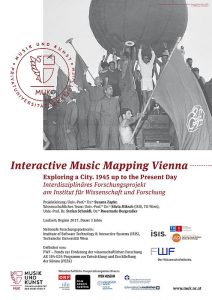
Interactive Music Mapping Vienna – Research Project

06/06/2018 by Leonard Sprueth | Comments Off on Interactive Music Mapping Vienna – Research Project

Exploring a City. 1945 up to the Present Day

Lead by Susana Zapke, keynote-speaker at our conference in November, this research project tackles the role of music in urban context as an instrument of social identification and the question of how music is symbolically used in municipal politics. The city of Vienna hereby functions as an example to point out the ways music can be responsible for creating specific city spheres and ideological subjects.

In this manner, cultural and social practices are looked upon to identify the modus operandi of the city as well as its social dispositions. Vienna’s site-specificity will thereby be attributed to the acoustic-tonal construct inherited.

This particular research-emphasis was developed through the entanglement of scientific and artistic approaches and practices of diverse projects at the MUK Vienna since 2012.

More info

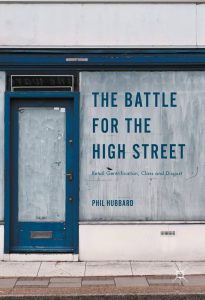
The Battle for the High Street – Book by Phil Hubbard

23/02/2018 by Alenka Barber-Kersovan | Comments Off on The Battle for the High Street – Book by Phil Hubbard

Hight streets in British cities often carry strong
meanings in terms of social an cultural status. In this
book, Phil Hubbard analyses their development in times of
recession and austerity and points out how high streets
are shown to have long been regarded as the heart of many communities, but have declined to a state where boarded-up and vacant retail units are a familiar sight.

The book provides a powerful argument against retail
gentrification, and a timely analysis of class conflict in
austerity Britain. It will be of great interest to
scholars of geography, social policy and cultural studies.

Phil Hubbard – The Battle for High Street, Retail
Gentrification, Class and Disgust

Palgrave Macmillan, London – February 2017

More: Link

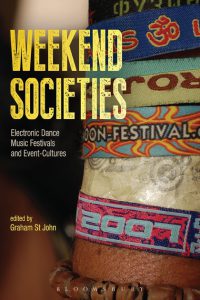
Weekend Societies – New Book by Graham St. John

12/02/2018 by Leonard Sprueth | Comments Off on Weekend Societies – New Book by Graham St. John

In Weekend Societies we are introduced to the emergent field of EDM (Electronic Dance Music) festivals and even-culture studies. Growing ubiquitous in contemporary social life, and providing participants with independent sources of belonging, these festivals and their event-cultures are diverse in organization, intent and outcome, EDM festivals are expressions of “freedoms” revolutionary and recreational.

Graham St. John points out an industry trend in the world dance music culture from raves and clubs towards festivals, featuring contributions from scholars of EDM festivals showcasing a diversity of methodological approaches, theoretical perspectives and representational styles.


Weekend Societies – Electronic Dance Music Festivals and Event-Cultures

Graham St. John – Bloomsbury Academic – 01.12.2017

More:

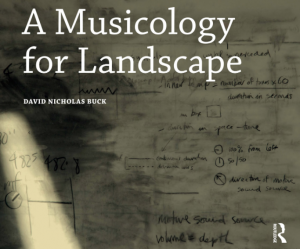
A Musicology for Landscape – New Book by David Nicholas Buck

03/01/2018 by Leonard Sprueth | Comments Off on A Musicology for Landscape – New Book by David Nicholas Buck

As the title suggests, David Buck’s recent publication concentrates on weaving sound into the sensory appreciation of landscape. Through conceptual and direct reference on musical notation, his work investigates landscape architecture’s inherent temporality and calls for refocusing  this under-researched aspect provided by the model of notating time. 

Being a landscape architect and educator, Buck’s work offers an innovative and contemporary approach to a wide range of landscape projects and as the founder of the “landscape architecture programme” at the University of East London, his design work in the UK and Japan has been widely published. During his PhD he focused on the investigation of alternatives for perspectival representations of space in landscape architecture through developing new notations from a synthesis with music, thus “A Musicology for Landscape” is evidently the latest in a succession of thriving works.

The book hereby addresses a difficulty within the architectural discourse, which is concerned with a lack of adequacy of the existing design tools to correctly explore the landscape’s inherited temporality. By seeking new forms of notation through the inclusion of musical notation, the book introduces three influential composers – Morton Feldman, György Ligeti and Michael Finnissy – presenting a critical evaluation of their work within music, as well as a means in which it might be used in design research. David Buck then juxtaposes musical scores with design representations by Kevin Appleyard, Bernard Tschumi and William Kent, until final examination through newly developed landscape architectural notations. Ultimately, bringing together musical composition and landscape architecture through notation, evokes a focused and sensitive exploration of temporality and sound in both fields.

David Buck – between landscape architecture and land art 

A Musicology for Landscape – 2017 – Routledge