Urban Music Studies

Scholars Network

06/10/2026
by R. Kuchar
0 comments

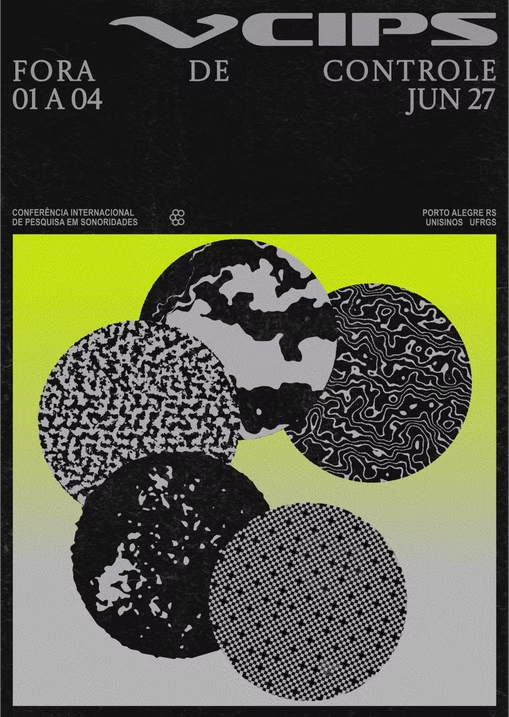
Call for Papers: V CIPS – OUT OF CONTROL

A massive sound system, blasting at full volume, spills beyond the dance party’s boundaries and shakes the tiles loose from a neighbor’s house. A streaming platform algorithm promises to normalize volume levels across songs from different eras. Civilians develop tinnitus from the deafening blast of a military-grade explosive. A mosh pit goads the bassist into stopping their performance to join the crowd. A resident develops anxiety, overwhelmed by the soundscape of a megalopolis’s ceaseless vertical construction. Musical creation lives a life of its own, where the room, the instrument, music history, musical systems, the weather, the power grid, and other elements displace individual human will in the process of making music. The ruckus of a beach—sonically saturated by the sea, portable speakers, the street vendor’s cryes, and beach sports on a sunny summer day—actually reveals a complex, sophisticated arrangement of leisure practices self organized by the place’s regulars.

The upcoming edition of CIPS aims to reflect on musical and sonic phenomena where the concept of control is radically intersected by forces beyond control. Not in opposition, but in a relationship of complementarity, overlap, and intertwining: we propose viewing the “out-of-control” as a foundational, explosive component of regulatory systems. It is about liminal moments—losing one’s footing and finding it again, transformed. Where distinct sounds meet, a form of self-organization begins to take shape—defined not by pre-existing criteria, but by rules that emerge as the audible relationship gains substance. After all, sounds invade us, make us vibrate, and transform the bodies surrounding them.

Perhaps sound is, in fact, a strange machine: one that simultaneously generates chaos, organization, cooperation, and transformation. It may be worth considering an acoustic ecology based not on prescribing what should or should not sound, but rather on the ways sounds accommodate—and impose themselves upon—one another in their constant movement of emerging and fading away.

The theme of Out of Control resonates with Porto Alegre — the host city for the V CIPS — as it currently rebuilds its music scenes while still reeling from the effects of the worst flood in its history. This disaster inundated thousands of homes, businesses, nightclubs, and cultural centers, further damaging a sector of the state’s economy that was already deeply fragile due to the COVID-19 pandemic.

The concept of being “out of control” also serves as a way to confront these and other catastrophes: persisting in the quixotic creation of sounds, charting diagonal lines of thought, sonifying lines of flight, and harmonizing or desynchronizing practices that either vie for or share the same territory. The expansive, sensory dynamic of sound establishes an inherently provocative relationship with the idea of control: it presents itself at times as something to be resisted, at others as something to play with, and at still others as an invitation to surrender to the chaos and order unleashed by its power.

Reflecting on these relationships, GEIST (Study Group on Image, Soundscapes, and Technologies) invites artists and researchers to submit artistic proposals and scholarly papers for the V International Conference on Sonorities Research (CIPS), to be held from June 1 to 4, 2027, in Porto Alegre, Rio Grande do Sul, Brazil. For the first time, the event will be co-hosted by two institutions: Unisinos on June 1 and 2, and UFRGS on June 3 and 4.

We welcome submissions involving any type of medium, format, or technology related to various aspects of soundscapes. Perspectives of interest for this edition include, but are not limited to:

  • The crisis of musical authorship and copyright;
  • The problem of cataloging, describing, and preserving sounds;
  • The controlled and statistical manipulation of sounds by artificial intelligence;
  • From functional apparatuses to the functionaries of apparatuses;
  • History/histories of control in music and sound;
  • Policies of musical and sonic (de)control;
  • Sound, listening, and self-management/self-organization;
  • Sound, listening, and the imposition/sharing of control;
  • Compositional control and practices of de-control;
  • Uncontrolled performances and performative control;
  • Musical and sonic epistemologies and ontologies: limitations of control;
  • Cultural control, censorship, streaming platforms, recommendation algorithms, artificial intelligence, and data control structures;
  • Systems for selecting sounds and music; control of musical circulation and consumption;
  • Improvising a way out: paths and lines of flight beyond control.

The organizing committee will assemble the panels based on thematic affinities among the submissions; papers need not adhere to a single one of these perspectives. It is not necessary (nor recommended) to specify a perspective when submitting a paper.

SUBMISSION OF ABSTRACTS FOR SCIENTIFIC PAPERS 

Abstracts for scientific papers and research projects must be submitted by November 24, 2026, to the email address cips.sonoridades@gmail.com in .doc (or .docx) format, with the subject line reading: “V CIPS – Resumo”.

The V CIPS will be an entirely in-person event; none of its activities will be broadcast online.

The text must be formatted using Times New Roman font, size 12, with 1.5 line spacing. The document must include the following information, in this order:

  • Proposal title;
  • Proponents, their respective email addresses and institutional affiliations (or primary professional activity); highest academic degree, occupation or field of work, and city, state, and country of residence;
  • An abstract of up to 500 words, outlining the theme, objectives, research problem, theoretical framework, methodology, and relevance to the event’s general theme;
  • A bibliography listing up to 5 titles.

Abstracts may be submitted in Portuguese, Spanish, or English. We will correspond with the paper’s lead author regarding the receipt and evaluation of the abstract.

SCHEDULE

September 24, 2026 – Call for papers opens

November 24, 2026 – Deadline for abstract submission

December 15, 2026 – Deadline for submission of evaluations and acceptance letters

January 29, 2027 – Deadline to confirm attendance at the event

February 19, 2027 – Announcement of the final list of confirmed papers

April 5, 2027 – Announcement of the complete event program

May 3, 2027 – Release of the event abstract book

June 1, 2, 3, and 4, 2027 – Event dates

SUBMISSION OF ABSTRACTS FOR ARTISTIC PERFORMANCES

V CIPS invites artistic proposals that address or relate to the event’s theme, “Out of Control”. Works of the following types will be evaluated under these conditions:

  • Performances and happenings: Duration of up to 20 minutes;
  • Installations: Up to 8 works will be selected for exhibition in common areas at Unisinos and UFRGS;
  • Sound or audiovisual pieces (up to 20 minutes):

If there is interest in exhibiting in other formats, please indicate this in the proposal for evaluation. APPROVAL IS SUBJECT TO INFRASTRUCTURE AVAILABILITY.

Only works that do not pose a risk to users or exhibition spaces, and that reflect good practices regarding democratic coexistence, tolerance, and general social interaction, will be accepted.

Proposals for artistic performances must be submitted by November 24, 2026, via the electronic form available at a link to be released starting October 1st. Please attach the files listed below in .doc (or .docx) format.

  • The text must be formatted in Times New Roman font, size 12, with 1.5 line spacing. The document must include:
  • Proposal title;
  • Proponents and their respective email addresses;
  • Description of up to 500 words;
  • For sound or audiovisual pieces: submit an MP3 or MP4 file of the piece or an excerpt (if already completed);
  • For installations: submit an image file showing the proposal/exhibition layout or assembly scheme;
  • Technique/Format and a brief description of required equipment (or technical rider);
  • Duration (for live performances), not exceeding 20 minutes;
  • Short biography of the author(s) (up to 100 words each), stating institutional affiliation (or primary activity), highest academic degree, occupation or field of work, and city and country of residence.

For further information, pease visit the conference´s website.

25/06/2026
by R. Kuchar
Comments Off on Conference 2026: Groove the City – Move the Streets & Urban Spaces

Conference 2026: Groove the City – Move the Streets & Urban Spaces

3rd International Conference of the Urban Music Studies Scholars’ Network supported by the Thematic Group for Public Spaces and Urban Cultures of the Association of European Schools of Planning (AESOP TG PSUC) and the TU Wien 

Date: September 17 – 19th, 2026, Vienna

Locations: mdw & TU Vienna

The field of Urban Music Studies has emerged as a vibrant interdisciplinary arena, exploring the dynamic interplay between music and urban life. At its core, this field recognizes sound as both a reflection and a constitutive element of urban life, deeply embedded in the spatial, social and cultural fabric of cities. Music shapes and is shaped by the rhythms of urban spaces, from bustling streets and quiet courtyards to iconic concert halls and underground clubs. This field draws upon and contributes to diverse academic disciplines. By engaging with a variety of perspectives from across the globe, it challenges dominant narratives and highlights the diverse ways in which music resonates within urban settings. 
In the realms of planning, urban design and architecture, the development and envisioning of cultural organizations has traditionally been concerned with grand works of opera houses and theatre buildings. Since the 1970s, however, the focus has shifted towards the inclusion of informal and more circular cultural agencies, many of them linked to relational conceptions of space, or to the further development of immersive and acoustic technologies. Public space researchers have embraced socio-cultural aspects of urban life to cultivate hope, yet have only randomly engaged with the power of urban music subcultures and scenes, and the study thereof, to contribute to neighborhood solidarity, collective work practices when building music spaces, or to the deep democratic aspects of a diversity of music cultures, and the intermezzos and crossovers between them, in the city.
Against this backdrop, the third international conference of the Urban Music Studies Scholars’ Network Groove the City – Move the Streets, takes place 17+19 September 2026 at mdw – University of Music and Performing Arts Vienna in combination with the Public Spaces, Urban Cultures and Hope Symposium of the Thematic Group for Public Spaces and Urban Cultures of the Association of European Schools of Planning (AESOP TG PSUC) at Technische Universität Wien (TU Wien) which takes place on the 18 September 2026. Both combined events seek to deepen this research field by examining the manifold mobilities that shape and are shaped by sound in urban contexts. This includes a critical engagement with the concept and materiality of “the street” as a multifaceted and symbolic terrain where social, cultural, and political processes unfold. 

To the preliminary programme

Information and Registration

08/12/2025
by R. Kuchar
Comments Off on Call for Papers: KISMIF Conference 2026, July 8th-11th, University of Porto

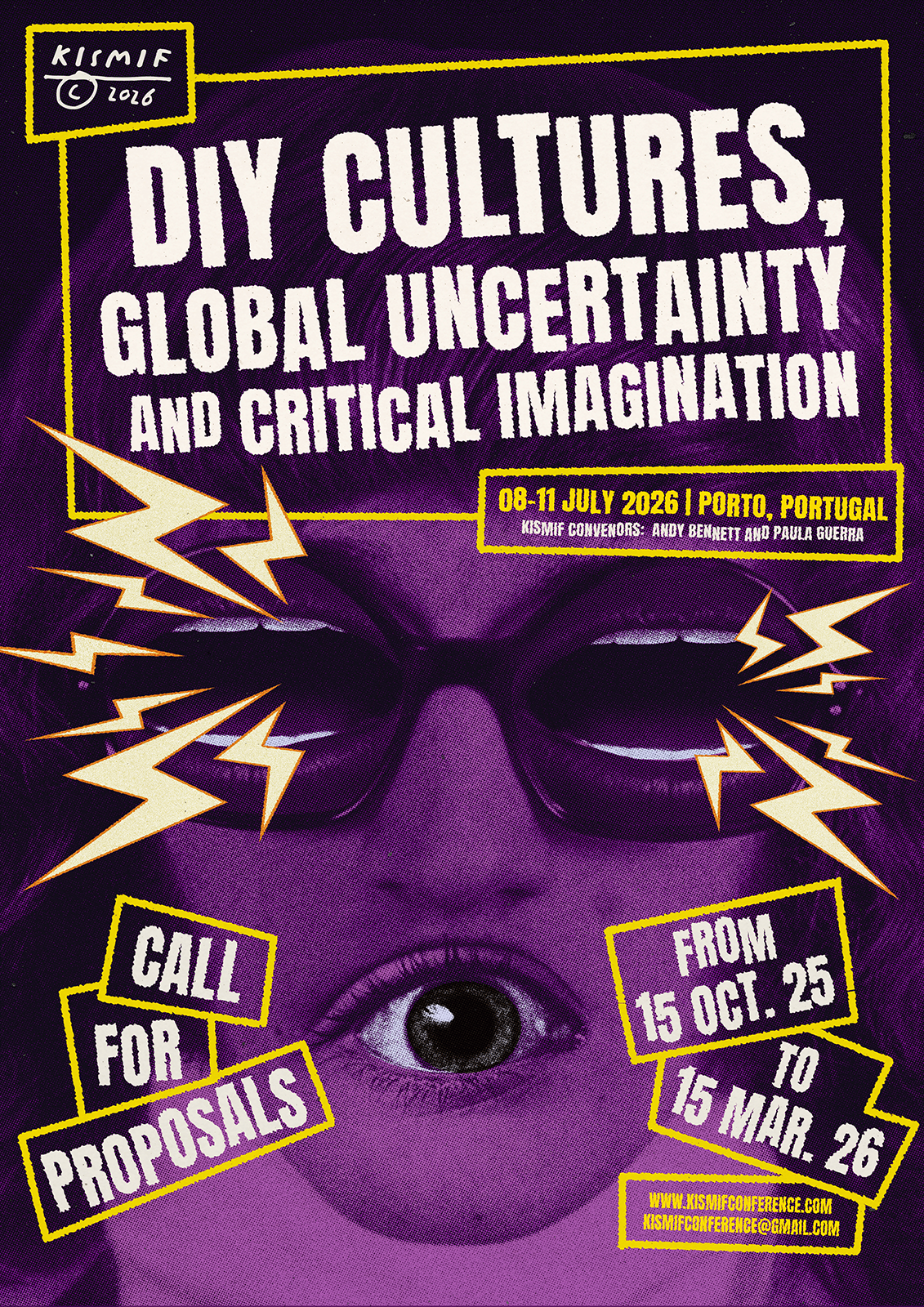
Call for Papers: KISMIF Conference 2026, July 8th-11th, University of Porto

KISMIF is coming! From July 8th-11th,2026,the next edition of KISMIF-conference will be held in Porto.

The thematic focus is set around ‘DIY Cultures,Global Uncertainty and Critical Imagination’.

The submission of abstracts for this Conference is open to researchers, academics, activists and artists working in all areas of sociology, anthropology, history, cultural economics, cultural studies, geography, philosophy, urban planning, media and cognate disciplines such as design, illustration, popular music, film, visual and performing arts. This initiative follows the great success of  the past seven KISMIF Conferences (held in 2014, 2015, 2016, 2018, 2021, 2022 and 2024) and brings together an international community of researchers, artists and activists focusing on alternative music-art scenes and do-it-yourself cultures. As such KISMIF 2026 will serve as a pivotal occasion of reunion and critical imagination around the societal fragmentation shaped by the multiple crises we are experiencing on an unprecedented scale.

Full Call for Paper see here.

More information about KISMIF-conference at the conference website


12/09/2025
by Alenka Barber-Kersovan
Comments Off on We Want More: Music / Sociology!

We Want More: Music / Sociology!

Call for papers for the International Popular Music Studies Conference 

Date: Wednesday 8 Apr 2026 – 10 Apr 2026 

Location:  Erasmus University in Rotterdam.

This conference focuses on the study of (popular) music from a sociological perspective. To that end, we invite a broad range of papers which explore music from different methodological and theoretical approaches and through diverse empirical data. We also welcome abstracts from our disciplinary friends, such as geography, cultural studies, and beyond. More: https://www.eur.nl/en/eshcc/events/we-want-more-music-sociology-2026-04-08

20/06/2025
by Alenka Barber-Kersovan
Comments Off on Groove the City – Move the Streets 

Groove the City – Move the Streets 

Groove the City – Move the Streets

3rd International Conference of the Urban Music Studies Scholars’ Network in cooperation with the Thematic Group for Public Spaces and Urban Cultures of the Association of European Schools of Planning (AESOP TG PSUC) 

Date: September 17-19, 2026

Location: Vienna, Austria


DOWNLOAD THE CALL FOR PAPERS HERE

Please submit your proposal via the online registration system before October 5th, 2025: https://www.conftool.org/groovethecity2026/.  


The field of Urban Music Studies has emerged as a vibrant interdisciplinary arena, exploring the dynamic interplay between music and urban life. At its core, this field recognizes sound as both a reflection and a constitutive element of urban life, deeply embedded in the spatial, social and cultural fabric of cities. Music shapes and is shaped by the rhythms of urban spaces, from bustling streets and quiet courtyards to iconic concert halls and underground clubs. This field draws upon and contributes to diverse academic disciplines. By engaging with a variety of perspectives from across the globe, it challenges dominant narratives and highlights the diverse ways in which music resonates within urban settings.

In the realms of planning, urban design and architecture, the development and envisioning of cultural organizations has traditionally been concerned with grand works of opera houses and theatre buildings. Since the 1970s, however, the focus has shifted towards the inclusion of informal and more circular cultural agencies, many of them linked to relational conceptions of space, or to the further development of immersive and acoustic technologies. Public space researchers have embraced socio-cultural aspects of urban life to cultivate hope, yet have only randomly engaged with the power of urban music subcultures and scenes, and the study thereof, to contribute to neighborhood solidarity, collective work practices when building music spaces, or to the deep democratic aspects of a diversity of music cultures, and the intermezzos and crossovers between them, in the city.

Against this backdrop, the third international conference of the Urban Music Studies Scholars’ Network Groove the City – Move the Streets, taking place from 17-19 September 2026 at mdw – University of Music and Performing Arts Vienna and at TU Wien – Technische Universität Wien, in combination with the 2024-2026 event series of the Thematic Group for Public Spaces and Urban Cultures of the Association of European Schools of Planning (AESOP TG PSUC), seeks to deepen this research field by examining the manifold mobilities that shape and are shaped by sound in urban contexts. This includes a critical engagement with the concept and materiality of “the street” as a multifaceted and symbolic terrain where social, cultural, and political processes unfold.

Streets, in their diverse manifestations, act as stages for buskers and political movements, as sites of vibrant musical scenes and cross-cultural learning, and as contested spaces where the rights to public access and representation are negotiated. The street is not merely a passageway or backdrop; it is a lived, embodied and performed space, as well as a space for hope, resistance, and transformation. It holds different meanings for various groupswhether as a cultural hub, a zone of in- and exclusion, a site of democratic everyday practice, or a canvas for reimagining the city towards more hopeful futures. From protests and demonstrations to public celebrations, cultural rituals and everyday rhythms, from marginalized communities reclaiming public spaces to ordinary performances of belonging, the relationship between music and the street reveals profound scientific insights into urban life.

In this conference, we adopt an expansive concept of (spatial) “movement” that encompasses social, cultural, and political dimensions. We are particularly interested in how “the street”— as a site of daily life, as a stage for artistic expression, as a realm of activist contestation, and political negotiation— becomes a focal point for musical practices. This conference seeks to explore how music mediates these relationships, foregrounding the tensions, solidarities, and possibilities that move the city when grooves meet the streets.

To this end, we invite scholars, practitioners, activists and artists to contribute to the conference by investigating how sound interacts with, transforms, and reimagines the streets as spaces of movement, resistance, belonging, and creativity. In doing so, we also shed light on the potentially democratizing and liberatory aspects of new sonic socio-technical approaches, and create bridges to architectural and planning practices that engage with infrastructural claims for musicians’ practices such as jamming, rehearsal, grooving and improvising.


Steering Committee

  • Sarah Chaker (mdw-University of Music and Performing Arts Vienna)
  • Lisa Gaupp (mdw-University of Music and Performing Arts Vienna)
  • Andrea Glauser (mdw-University of Music and Performing Arts Vienna)
  • Sabine Knierbein (TU Wien)


Academic and Artistic Board

  • Leni Augustin (TU Wien)
  • Alenka Barber-Kersovan (Leuphana University of Lüneburg)
  • Seo-Young Cho (mdw-University of Music and Performing Arts Vienna)
  • Gabriella Esposito de Vita (National Research Council of Italy CNR)
  • Michael Getzner (TU Wien)
  • Paula Guerra (Universidade do Porto)
  • Ebba Högström (Umeå University)
  • Volker Kirchberg (Leuphana University of Lüneburg)
  • Robin Kuchar (Leuphana University of Lüneburg)
  • Anastasiia Mazurenko (Slovenian Academy of Sciences and Arts)
  • Matej Nikšič (Urban Planning Institute of the Republic of Slovenia)
  • Luciana Ferreira Moura Mendonça (Universidade Federal de Pernambuco)
  • Richard Pfeifer (TU Wien)
  • Karl Salzmann (Universität für angewandte Kunst Wien)
  • Will Straw (McGill University)
  • Tihomir Viderman (TU Wien)

CfP Sound, Politics, and the Urban Laboratory

13/03/2025 by Alenka Barber-Kersovan | Comments Off on CfP Sound, Politics, and the Urban Laboratory

Call for Papers: isaResearch Summer School 2025

Sound, Politics, and the Urban Laboratory

July 21–23, 2025 | Vienna

mdw – University of Music and Performing Arts Vienna

As part of isa – International Summer Academy of mdw, the isaResearch Summer School 2025 seeks to explore the dynamic relationship between sound, urban space, and politics. Thanks to its rich historical musical tradition, Vienna has been called and marketed itself as “City of Music” – a label that must be critically examined both as a trope as well as within the neoliberal logic of the creative industries.

Using the notion of the “Music City” as a starting point, the three-day workshop invites Ph.D. students and other early-stage researchers in the humanities and artistic research, specifically those immersed in music, sound, and urban studies, to present and discuss their own research around the topic. Taking place on campus of the mdw, this interdisciplinary forum seeks to examine the political economies of sonic expression and musicking in public space and urban life. We also encourage reflections on the fluid relationship between cities and music, borders and mobility.

Participants will be able to present and discuss their research project in an interdisciplinary framework. Experts in the respective field at the mdw and beyond will engage in conversations and act as respondents. The programme will also include a keynote lecture by an international expert, site-visits in the urban landscape of Vienna as well as options to participate in other isa events. The summer school thus sets out to explore the transformative role of sound in shaping public environments and to provide participants with an intimate interdisciplinary experience that fosters new networks and perspectives.

Submissions may address, but are not limited to, the following themes:

  • Inequality & Power Critique: How does sound influence social segregation and hierarchies in the urban environment?
  • Sound in Public Space: Sound design as a means of shaping identity, security, or control.
  • Mapping Urban Music Cultures: Historical and contemporary mappings of music venues and soundscapes as critical method.
  • Music & Community Spaces: How do musical practices contribute to the creation and transformation of community spaces, particularly for minoritarian communities?
  • Fluid Concepts: The relationship between cities and music in the context of water, borders, and mobility, e.g. the river Danube as a historical route of travel and migration
  • Music & Agency: Music as a tool for claiming urban spaces, resistance, and the ‘Right to the City.’ How do regulations and governance shape sonic expression?
  • Mental Health & Soundscapes: The impact of urban sounds on mental well-being and social
  • Genre Evolution and New Urban Sound Aesthetics: Hip-hop, electronic music, and transcultural music scenes as forms of urban self-expression


We invite applications from Ph.D. students and other early-stage researchers from disciplines including (but not limited to) Musicology, Dance and Performance Studies, Urban Studies, Artistic Research, Queer Theory, Cultural Studies, Music Theory, Indigenous Studies, Music Sociology, Critical Race Studies, Ethnomusicology, Popular Music Studies, Post-Colonial Studies, Art History, and Film and Media Studies. Presentation proposals should be connected to the topic of the participant’s thesis or current research project.

Attendance of the summer school is free of charge, and mdw provides lunch and refreshments on-site. Limited funding to help with travel and accommodation expenses is available. The exact amount of funding will be decided on a case-by-case basis according to the requirements of the participant. Application is possible after the acceptance of your proposal with a short description of your situation and academic affiliation (or lack thereof). We are happy to organize childcare for researchers travelling with children of any age; we kindly ask to be informed of any such needs as soon as possible after acceptance.

Applications including a title, a presentation abstract, keywords, a statement of motivation, and a short bio must be uploaded via our website. The deadline for applying is April 28, 2025.

Decisions on the acceptance of proposals will be announced in early May 2025.

Contact: Kathrin Heinrich isaresearch@mdw.ac.at

Websites:

https://www.isa-music.org/de/isaresearch/

https://www.mdw.ac.at/forschungsfoerderung/isaresearch/


Organization: Kathrin Heinrich, Therese Kaufmann

Academic Advisory Board:

Univ.-Prof. Dr.habil. Lisa Gaupp, Professor for Cultural Institutions, IKM

Scott L. Edwards, PhD, Institute for Musicology and Performance Studies

Dr. Magdalena Fürnkranz, Senior Scientist, Theory and History of Popular Music, iPOP

05/03/2025
by Alenka Barber-Kersovan
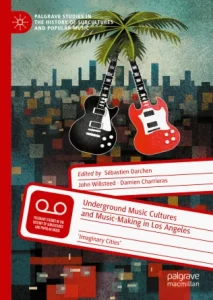
Comments Off on Underground Music Cultures and Music-Making in Los Angeles

Underground Music Cultures and Music-Making in Los Angeles

This book edited by Sébastien Darchen, John Willsteed and Damien Charrieras focuses on the relationships between underground urban music cultures in Los Angeles and specific urban imaginaries related to music practices, far away and sometimes in stark opposition to the commodified image of the city crafted by urban planners and associated urban stakeholders. Rather than this commodified city, and the ‘imaginary city’ of the mind, it examines the accidental, tangential life of a mirage. The city that appears in the distance is one that is formed by songs and music-making. The book shows how counter urban imaginaries emerge and are performed through diverse underground music making practices, giving rise to alternative ways of seeing the city.

See more here Underground Music Cultures and Music-Making in Los Angeles: ‘Imaginary Cities’ | SpringerLink

17/10/2024
by Alenka Barber-Kersovan
Comments Off on Sustainable Cities and Cultures of Music

Sustainable Cities and Cultures of Music

We are pleased to invite you to attend the ERASMUS+ (Music4Change) funded International School Sustainable Cities and Cultures of Music from November 5-8, 2024 at the University of Groningen. This school (offering 3 ECT points) is geared towards scholars and graduate students (MA and PhD) and features panels, workshops, soundwalks, concerts, and a keynote lecture by Prof. Ellen Waterman (Carleton University).

Performances and interactive music activities are planned by DJ Juan Chao (from Uruguay), Hans Fidom (Groningen’s organs), and many other local musicians.

The school is free and open for interested scholars, students, and music professionals.

To attend you can register here

17/09/2024
by R. Kuchar
Comments Off on SAVE THE DATE – NEXT GROOVE THE CITY CONFERENCE IN 2026

SAVE THE DATE – NEXT GROOVE THE CITY CONFERENCE IN 2026

With great pleasure we would like to announce that the Urban Music Studies Network comes back to event activities started with the 2018 Groove the City Conferences.

And we have very good news: Groove the City is back! Save the date for „Groove the City – Move the Streets“ – our next International Urban Music Studies Conference that will be held in Vienna from Sept. 17th – 19th, 2026.

More information and Call for Papers will follow very soon…

09/08/2024
by Alenka Barber-Kersovan
Comments Off on From Broadway to The Bronx – New York City’s History through Songs

From Broadway to The Bronx – New York City’s History through Songs

Edited by Veronika Keller and Sabrina Mittermeier this book brings a vibrant depiction of New York City in song across a variety of different genres, focusing on Broadway, musical theatre, hip hop, punk, folk, and jazz genres, as well as the work of New York born artists and those who are intimately connected with the city.
More information here https://www.intellectbooks.com/from-broadway-to-the-bronx